
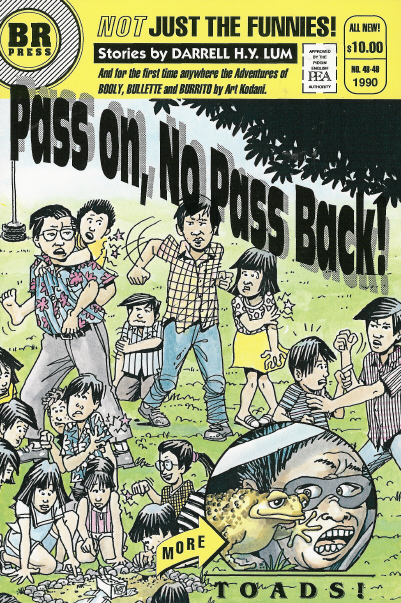
Pass On, No Pass Back!
Mahalo for reading and buying local! You can purchase this title online through our fulfillment partner, Bess Press.
$10.00
Darrell Lum’s signature pidgin narratives dominate this nine-story collection, which also includes standard English stories and comic strip illustrations. Endearing and insightful, Lum’s characters tell stories of initiation, family, wonder and community. In Pass On, No Pass Back!, “community is not defined by delineating boundaries, but by moving the center outwards to include what has traditionally been defined as marginal. Lum’s is a vision of the possibility once expressed by Derek Walcott that ‘the highest expression of culture is a total acceptance of every human being.'” — The Mid-American Review
Winner of the 1992 Association for Asian American Studies National Book Award and the 1991 Elliot Cades Award for Literature.
From HONOLULU MAGAZINE’S 50 Essential Hawai‘i Books You Should Read in Your Lifetime:
“Only in Hawai‘i” probably best describes these stories, whose unassuming titles—“Victor,” “Horses,” “Toad”—launch readers into their young characters’ stream-of-pidgin consciousness. Cartoons by Lum’s intermediate school classmate, Art Kodani, add deadpan absurdity. A local treasure, where pidgin meets modernism.
| Author | |
|---|---|
| ISBN | 910043191 |
| ISBN-13 | 978-0910043199 |
| Year Published | |
| Number of Pages | 128 |
| Weight | 7.2 oz |
| Dimensions | 9 × 6 × 0.5 in |
Related products